Space
Record ceiling height, surfaces, daylight, key viewpoints and mounting limitations. A narrow beam behaves very differently on a low ceiling than it does across a double-height lobby.
Room · task · budget
Start with how people use the space, then balance distribution, visual comfort, color quality, control needs and cost. This guide is a conversation framework, not a substitute for project calculation.
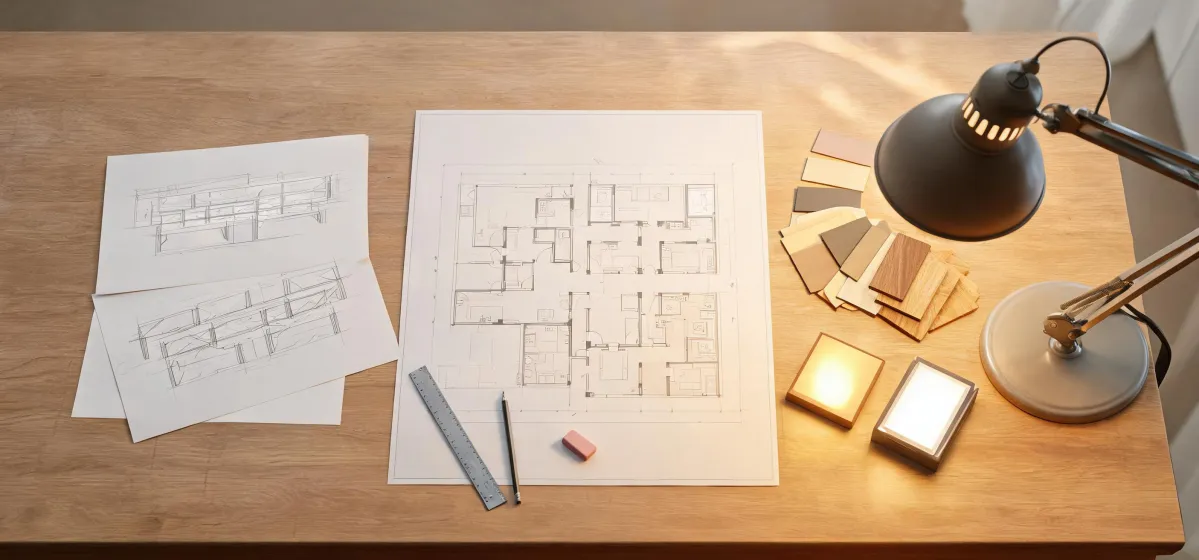
Good selection is not a race toward the highest luminous efficacy or the most dramatic form. It is a sequence of questions that connects what the eye experiences to what the project can install, control, maintain and afford.
Record ceiling height, surfaces, daylight, key viewpoints and mounting limitations. A narrow beam behaves very differently on a low ceiling than it does across a double-height lobby.
Name what must be seen: faces, merchandise, artwork, documents, circulation edges or a dining table. Define whether emphasis, uniformity or adaptation matters most.
Consider installed cost, controls, commissioning and service access—not fixture price alone. A coherent family can simplify spares and visual coordination across rooms.
Decide whether the first job is orientation, ambient light, task support, accent or atmosphere.
Use luminous flux, candela distribution and beam angle in relation to distance and target size. Avoid comparing wattage without optical context.
Review shielding, viewing angle, UGR context, CRI, TM-30 information and CCT. A higher lm/W option may still be the wrong fit if it weakens visual comfort.
Confirm driver location, dimming protocol, minimum dim level, zoning, ceiling interface and access. DALI-2 and 0-10V are not interchangeable labels.
Use photometric calculation, mockups where appropriate and applicable compliance documents before approval. Confirm product-specific UL, CE or RoHS status for the destination.
LM-79 data can describe measured luminaire performance; LM-80 and TM-21 relate to LED package maintenance projections and should not be casually presented as the same thing as a complete luminaire warranty. For integrated decorative products, ask how drivers or light engines are accessed and what the service path looks like. For replaceable components, check compatibility and whether the visual result remains consistent.
We can help you compare options against the space, task and budget without losing sight of atmosphere.
Review a lighting brief